7-Step Employee Motivation Checklist for Managers & HR
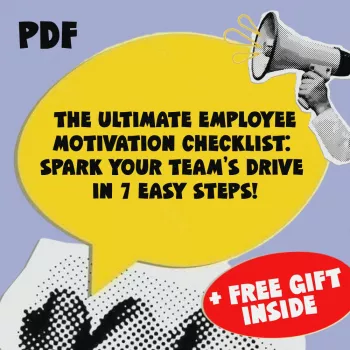
The Ultimate Employee Motivation Checklist: 7 Steps to Spark Your Team’s Drive
Motivation rarely collapses because people “don’t care.” It fades when priorities blur, progress goes unseen, and daily friction piles up. Our Ultimate Employee Motivation Checklist turns motivation into a repeatable routine: seven simple steps that help leaders and HR teams create clarity, momentum, and a culture where people want to do great work. Use it as a weekly reset, a monthly culture tune-up, or a quick intervention when energy dips.
What this checklist is designed to fix (fast)
If your team’s energy feels inconsistent, you’re usually dealing with one (or more) of these fixable issues:
- Inconsistent expectations: different standards across managers, teams, and projects.
- Low follow-through: goals exist, but accountability and progress signals are missing.
- Invisible wins: effort is happening, but recognition isn’t timely or specific enough to reinforce it.
- Friction overload: processes, interruptions, and unclear ownership drain energy more than the work itself.
- Disconnected work: employees can’t see how daily tasks connect to customers, outcomes, or growth.
These are the levers that matter most when you want steady engagement—especially when you align autonomy, competence, and relatedness (a core idea in Self-Determination Theory).
How to use the 7-step routine without adding meetings
Our team built this routine to be lightweight. You don’t need a new standing meeting—just a consistent pulse that keeps priorities, blockers, and recognition visible.
- Pick one rhythm: weekly (15–25 minutes), biweekly (30 minutes), or monthly (45–60 minutes). Consistency matters more than intensity.
- Assign one owner: a manager, team lead, or HR partner who keeps the checklist moving and captures decisions.
- Run it as a “pulse,” not a performance review: focus on removing blockers and increasing clarity, not evaluating personalities.
- Use a single shared page: track actions, owners, and dates so improvements don’t disappear after the conversation.
7 steps at a glance (printable-friendly plan)
| Step | What to check | One action to take today | Time |
|---|---|---|---|
| 1. Align goals | Everyone knows the top 1–3 priorities | Rewrite priorities as outcomes + due dates | 5–10 min |
| 2. Clarify ownership | No task floats without an owner | Assign one accountable person per outcome | 5 min |
| 3. Remove friction | Top blockers are named and ranked | Fix the #1 blocker or schedule a fix with a deadline | 10–15 min |
| 4. Track progress | Progress signals exist (simple metrics) | Add one visible progress marker to the team board | 5–10 min |
| 5. Recognize wins | Recognition is specific and timely | Give one “what you did + impact” shout-out | 3–5 min |
| 6. Support growth | Skill-building matches upcoming work | Pick one micro-skill focus for the next sprint | 5–10 min |
| 7. Reinforce culture | Behaviors match values in daily decisions | Name one value-linked behavior to repeat next week | 5 min |
Step 1–2: Create clarity that people can trust
Motivation rises quickly when people know what “winning” looks like and who owns what.
- Turn goals into outcomes: swap vague targets (“improve service”) for measurable outcomes (“reduce response time to X by date”).
- Limit priorities: more than three “top priorities” signals that nothing is truly top.
- Define ownership clearly: one accountable person per outcome, with collaborators listed separately.
- Make “done” visible: define what completion looks like (checklist, metric, approval, or customer result).
- Use consistent language: outcome, owner, due date, and next action should appear in every project update.
Step 3–5: Build momentum with less friction and better feedback
Small, consistent wins compound. Research on progress and morale backs this up—see Harvard Business Review on the power of small wins.
- Identify friction sources: unclear handoffs, tool overload, interruptions, and slow approvals are common culprits.
- Fix one thing per cycle: motivation improves when people see recurring obstacles actually removed.
- Add a single progress signal: one metric, one chart, or one “traffic light” status that the whole team understands.
- Recognize behavior, not just results: praise the actions that lead to repeatable success (preparation, collaboration, customer empathy).
- Use the recognition formula: “What you did” + “Why it mattered” + “Who benefited.”
If you want a practical benchmark for why consistency matters, Gallup’s engagement research consistently points to the role of clear expectations and ongoing feedback in performance.
Step 6–7: Grow capability and culture at the same time
Common motivation traps (and the checklist-friendly fixes)
Printable PDF workflow: where this checklist fits in the week
Tools our team keeps on hand (so you can act fast)
- The Ultimate Employee Motivation Checklist (Printable PDF Download): Use this as your weekly or monthly “reset” page to lock priorities, owners, and next actions.
- TikTok Sprint Blueprint: 7-Step Weekly Content Checklist: If part of your team’s work is content or campaigns, this gives you a parallel sprint structure so deliverables don’t drift.
- Preventing and Relieving Screen-Induced Eye Strain (Practical eBook Guide): When focus time is a priority, reducing screen fatigue can support longer, higher-quality work blocks.
FAQ
Is this checklist better for managers or HR teams?
It works for both. Managers can run it with their team to create clarity and momentum, while HR can standardize the routine across departments, coach leaders, and track recurring friction themes that need system-level fixes.
How quickly can motivation improve using the 7 steps?
Some gains can show up immediately—especially from clearer priorities, specific recognition, and removing one major blocker. Deeper culture shifts typically take consistent cycles over several weeks as the habits become the norm.
Can the checklist work for remote or hybrid teams?
Yes. The key is using one shared doc or board, making ownership explicit, and keeping progress signals visible to everyone; written recognition also helps reinforce wins across time zones and schedules.














Leave a comment