Spice Shelf Organization: A Simple System That Sticks
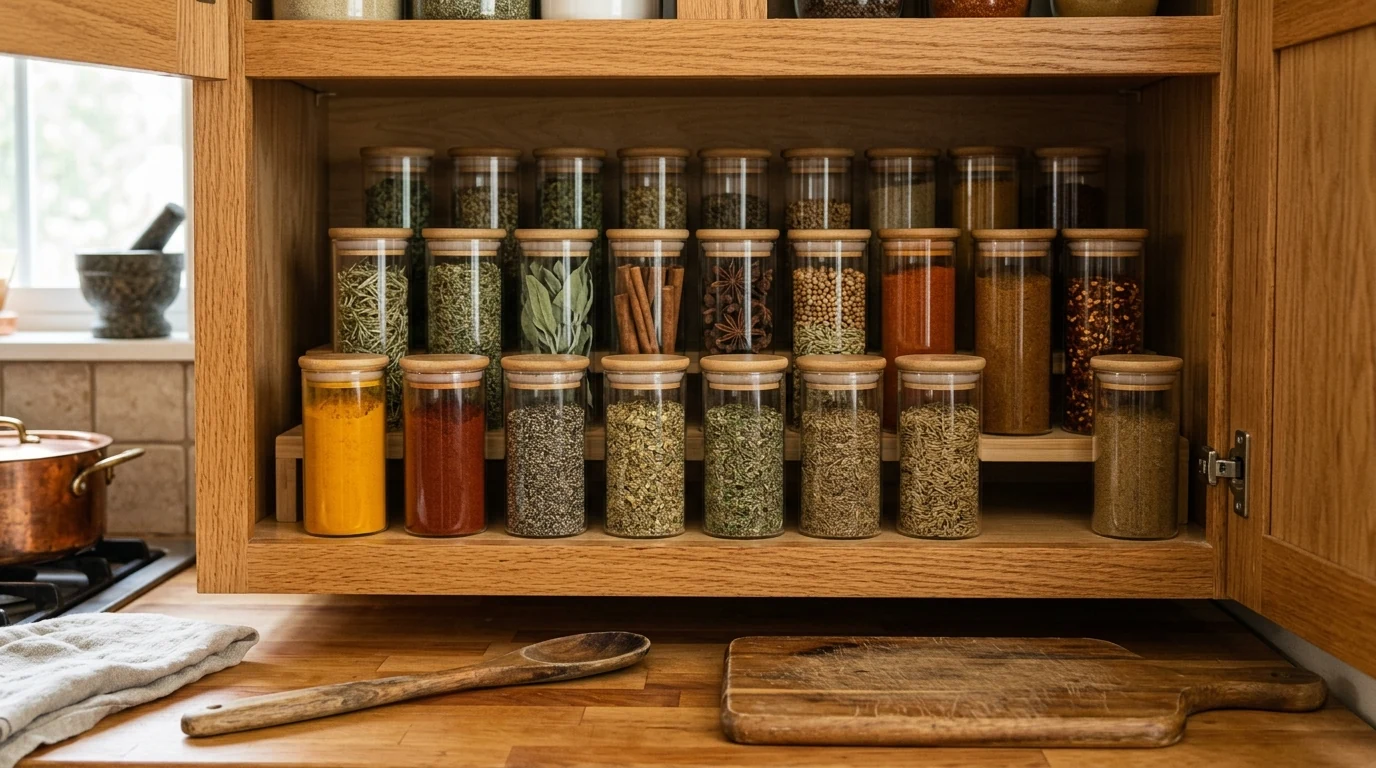
Spice Sense: Mastering the Art of Organized Flavor for a Beautiful, Efficient Kitchen
A well-organized spice shelf turns everyday cooking into a smoother, more joyful routine—no more duplicate jars, faded labels, or digging behind oils to find cumin. Our team put together a simple, repeatable system you can use to sort, store, label, and maintain spices so flavors stay easy to reach, easy to see, and easier to use consistently.
Why spice organization changes the way a kitchen works
- Faster cooking: the right spice is visible and reachable at the moment it’s needed, so you stay in rhythm instead of hunting mid-recipe.
- Less waste: fewer duplicates and fewer forgotten jars expiring in the back of a cabinet.
- More consistent flavor: a clear inventory helps you cook from what’s fresh and restock what you actually use.
- A calmer counter: when spices have a defined home, they stop migrating across the kitchen.
Reset the shelf: a 20-minute spice audit that actually sticks
If you only do one thing, do this. The goal isn’t perfection—it’s a clean baseline you can maintain.
- Pull everything out and group by type: everyday basics, baking, blends, heat, herbs, specialty.
- Check condition: clumping, dull color, weak aroma, or a “dusty” taste are signs it’s time to replace.
- Consolidate duplicates: keep the freshest; combine only if both smell strong and match exactly.
- Set a backstock rule: extra refills live in one clearly marked bin, not behind the front row.
- Decide your must-haves: keep a core set in the prime zone; store rarely used items higher or farther back.
For freshness basics and storage conditions, solid guidance is available from the University of Minnesota Extension and McCormick’s spice storage overview.
Choose an organizing style that fits your space (not the other way around)
Your best setup depends on cabinet depth, drawer space, and how many spices you actually use week to week.
| Setup | Best for | Keep in mind |
|---|---|---|
| Tiered riser in a cabinet | Medium-to-large collections that need visibility | Measure cabinet height; choose labels that read from the front |
| Drawer organization | Fast scanning and tidy lines | Use top labels; avoid overcrowding so jars don’t roll or overlap |
| Turntable in a deep cabinet | Hard-to-reach spaces | Group by category to prevent random spinning |
| Single shelf row | Small collections | Uniform containers reduce visual clutter and lost jars |
| Wall rack | Saving cabinet space | Keep away from heat/sun; choose a stable spot away from steam |
- Cabinet shelf (single layer): great for small collections; prioritize uniform containers and front-facing labels.
- Tiered riser: adds “stadium seating” so every label shows at a glance.
- Drawer layout: quick scanning; labels on jar tops keep lines neat.
- Lazy Susan/turntable: ideal for deep cabinets; categories prevent the spin-and-search problem.
- Wall rack: frees cabinet space; keep away from sunlight, heat, and steam for longer-lasting flavor.
Build a “flavor map”: the simplest way to find everything instantly
Once you pick a logic, stick to it. That’s what makes your shelf feel “obvious” every time you cook.
- Pick one primary organizing rule: alphabetical OR by cuisine OR by use-case (weeknight, baking, grilling).
- Use category dividers: keep blends together, baking together, and heat elements together (chili flakes, cayenne, etc.).
- Reserve a front-row “daily drivers” zone: salt, pepper, garlic powder, onion powder, paprika, cumin—customize to your cooking style.
- Keep frequently paired items adjacent: taco seasonings near cumin/chili; baking spices near vanilla/sugar (in pantry).
- Create a “specialty zone”: occasional items live together so they’re easy to find without crowding essentials.
Labels, containers, and freshness: what matters most
A maintenance routine that prevents the mess from coming back
Put the system together with our guides
If you want a step-by-step plan you can follow without overthinking, our team built Spice Sense: Mastering the Art of Organized Flavor to take you from a cluttered shelf to a clean, repeatable setup. You’ll use practical frameworks for sorting, zoning, and labeling—plus a maintenance rhythm designed for real kitchens, where you need fast resets and fewer duplicates.
If you also like systems for the rest of home life, you may want to pair it with one of our other checklists-based resources: Hashtags to Go Viral on TikTok: The Ultimate Checklist for Boosting Your Reach (for creators who want a ready-to-use process) and Everyday Pet Safety Kit for a Fully Pet-Proof Home (for a room-by-room, prevention-first home routine).
FAQ
How should spices be organized for the fastest cooking workflow?
Pick one primary rule (use-case is often fastest, alphabetical is simplest), then keep a front-row “daily drivers” zone and group everything else by category. Place frequently paired items next to each other so you can season without breaking your cooking flow.
Where is the best place to store spices in the kitchen?
Store spices in a cool, dark, dry spot away from heat, sunlight, and steam, such as a pantry cabinet or a drawer away from the stove. Keeping them next to heat sources can shorten their peak flavor and aroma.
How often should spices be replaced?
Replace spices when the aroma is weak, the color looks dull, or you notice clumping or a stale, dusty taste. Whole spices usually last longer than ground spices, and dating your jars makes the decision much easier over time.













Leave a comment